A power cut starts quietly. The light goes out, the fridge falls silent, and for a moment the flat is very still. Most outages in Germany are over inside an hour. This is about the ones that are not: what you do in the first twelve hours, and what you are better off not doing, because the early decisions decide whether this ends as one evening without television or with a spoiled freezer and a fire in the flat.
The first fifteen minutes: is it me or is it the grid?
Before anything else, settle one question: is the fault in your own wiring, or in the grid? Everything that follows depends on the answer.
- Look at the consumer unit. If a breaker or the residual current device has tripped, the fault is inside your home. Switch off whatever was running when the power died, then reset it. If it trips again straight away, leave it down and call an electrician.
- Look out of the window. Street lights, neighbouring houses, the block opposite. Dark everywhere means the grid is down.
- Knock on a neighbour's door. The doorbell is dead without power. Knocking answers the question in ten seconds, and it is the first chance to see who in the building lives alone, is elderly, or depends on a powered device. And if somebody is stuck in a lift, it is now.
- Call the network operator, not the emergency number. The fault-reporting number is printed on your electricity bill. It belongs on a note taped inside the consumer unit, not only on your phone: a dead battery shows no photographs. Emergency numbers are for emergencies, and in a large-scale outage they are jammed anyway.
The reason for the first move only becomes obvious the next morning: if the electricity comes back unnoticed at three, a hob left switched on is still heating a pan that boiled dry hours ago. So the hob, the oven, the iron and the fan heater go off before anything else happens. Leave one lamp on. It is your signal that the power is back.
How long does the cold last?
The most important rule fits in two words: keep it shut. A closed fridge keeps food cold enough for roughly four hours, and a well-filled chest freezer holds for up to two days depending on model and load. Every time the door opens you lose a chunk of that. Checking every twenty minutes whether it is still cold is a reliable way to make sure it no longer is.
| Appliance | Holds roughly | Notes |
|---|---|---|
| Fridge, kept closed | 4 hours | After that the temperature climbs fast. Whatever has to go, goes on the table first. |
| Chest freezer, full | up to 48 hours | Full beats half full. Fill the gaps with water bottles: frozen solid, they hold the cold far longer. |
| Freezer compartment in a fridge | a few hours | Small volume, little mass. The first casualty, and the one to empty first. |
| Cool box with ice packs | 12 to 24 hours | Your reserve for insulin and other medication that needs the cold chain. |
When the power returns: anything that still carries ice crystals, or that stayed below 4 °C throughout, may go back into the freezer. Anything that thawed but stayed cool gets cooked through and eaten. Anything that sat warm for more than two hours goes in the bin, even if it still smells fine: heat kills the bacteria but not the toxins they have already produced. Minced meat, poultry, fish and dishes containing raw egg are the risky items, not the bread and not the vegetables.
In practice, that shapes the first evening: you cook whatever is thawing anyway, and the emergency food supply on the shelf stays untouched. It is there for day three, not for hour one.
Light: why candles are the worst answer
Candles are the romantic response to a power cut and the dangerous one. Fire services report house fires after every major outage, and the cause is almost always the same: an open flame next to a curtain, a stack of paper or a child's hand, in a home where nobody can see what just got knocked over. If you do use candles, put them on a solid surface, never on a shelf under something flammable, and blow them out when you leave the room.
Electric light is better, in this order:
- One head torch per person. The only light source that leaves both hands free. Anyone walking down a dark staircase, hunting for a fuse box or changing a nappy notices the difference immediately.
- One camping lantern per room, pointing at the ceiling. It gives you a lit room instead of a cone of light.
- The phone torch as a stopgap, never as the plan. It eats exactly the battery you will want for phone calls later.
Batteries belong with the lamp, not in a drawer three rooms away. Once a year, check which ones still have charge and bin anything starting to leak. A device with a crank or a small solar panel is what is left when the batteries give up before the outage does.
When the mobile network goes down too
Mobile networks do not survive a power cut for long. Base stations have backup batteries, but their runtime is usually somewhere between half an hour and a few hours depending on the site. Once the masts around you drop out one by one, your phone is a camera with a torch. That is why warning apps and cell broadcast stop being any use in a longer outage while a radio keeps working: one needs a network, the other does not.
What follows from that:
- Make your calls while you still can. The important ones (relatives, care services, employer) belong in the first hour, not the fourth. On a congested network a short text message gets through where a call does not.
- Flight mode saves battery. A phone hunting desperately for a network that is no longer there is flat within hours. Agreeing fixed times when everyone switches their phone on is an old trick and still the best one.
- Radio is the fallback. A battery or wind-up FM radio will pick up a signal for as long as any transmitter is on air, and transmitters have backup power. A car radio works too, but never with the engine running in a closed garage, and not for so long that the car battery is flat afterwards.
- Cordless phone and router are dead. Landlines run over the router these days. No power means no internet, no wifi, no door intercom and, in many buildings, no electric door release either.
Emergency calls still work as long as any network is reachable: phones will use whichever network is available, not only your own provider's.
Heating, hot water and running water go with it
Almost every modern heating system needs electricity, gas and oil boilers included, for the controls, the pump and the fan. Without power the flat cools slowly: unnoticed in summer, obvious within a day in January. The answer is not a gas heater in the living room (carbon monoxide has no smell and kills people in their sleep) but one room instead of a whole flat: doors closed, blankets and sleeping bags, everyone together in the smallest room, curtains shut at night and open by day.
Water can fail as well. Waterworks normally have backup generators; the booster pump in a block of flats does not. From the third or fourth floor upwards, nothing comes out of the tap. If the power is gone and water is still running, you have a window nobody announces: bathtub full, canisters full, every pot full, in that order. How much a household needs over a longer period, and what to keep it in, is in the piece on emergency water supply.
What has to be ready beforehand
Nothing on this list is expensive, and not one item can be sorted out at eight in the evening in the dark.
| What | Why |
|---|---|
| A head torch per person, spare batteries | Hands free, instantly usable, no fire risk. |
| FM radio with batteries or a crank | The only source of information without a network. |
| Charged power bank and the right cable | Buys your phone another day or two. |
| Cash in small notes | Card payment and cash machines are the first things to go. |
| Food you can eat cold | The electric hob is off and so is the kettle. |
| Two days of water within reach in the flat | Pumps inside the building have stopped. The ten-day supply is in the cellar and is no help upstairs. |
| Fault-reporting number and emergency contacts on paper | A dead phone knows no phone numbers. |
| Medication, and a plan for the cold chain | Insulin and similar drugs need a cool box with ice packs. |
Affiliate links: This post links to products on Amazon. If you buy through them we earn a small commission; the price stays the same for you. As an Amazon Associate we earn from qualifying purchases. We still only recommend what we would recommend without a commission. The data protection side is explained in our privacy policy.
What is actually in my cupboard
The table lists categories, and nobody buys a category. So here are the three devices that have been sitting ready in my flat for years, each with the thing that annoys me about it. They are deliberately not expensive specialist kit: the gap between "nothing" and "something that works" is large, the gap between "works" and "perfect" is not.
- A wind-up radio that doubles as a lamp and a power bank. Mine is a unit with a crank, a small solar panel, a built-in battery and an LED light. Honestly about the crank: a minute of winding buys a few minutes of radio, which makes it the last resort rather than a power supply. The built-in battery is where the real value sits, the solar panel trickles in slowly, and the compass moulded into the case is decoration. What matters is that it picks up FM when nothing else in the building works.
- A large power bank for the phones. In my case an Anker 325 with 20,000 mAh, good for several phone charges. It is not light and it is almost too bulky for a rucksack, but it lives at home anyway. The model matters less than the habit: top it up every few months, or it will be sitting at thirty percent on the day it counts.
- Batteries as a bulk pack, not as blisters. Mine is a bulk pack of alkaline AAs. The reason is unglamorous: single blisters are always empty exactly when you need them. Alkaline cells keep for years in a cupboard, so a stock is cheaper than forgetfulness. Check first which size your torches and your radio take; AAA is just as often the answer.
What is missing here and still sits at the top of the list: a head torch per person. I do not yet own one I would stand behind, and there are no recommendations on this site for things I have not used.
How Keepilo helps
The awkward part of a power cut is that it switches off precisely what the preparation was stored on: the phone with the notes, the computer with the list, the internet with the instructions. Keepilo is built to work offline. The emergency area lives on the device: emergency contacts, medical cards for everyone in the household, guidance on what to do, and emergency cards as a PDF you print once and put in your wallet.
The AI assistant answers without internet too, because the language model and the documents both sit on the device. If you want to know at half past ten at night how long the mince from a thawing freezer is still usable, you get an answer that names the book and the page it came from, with no network and no account.
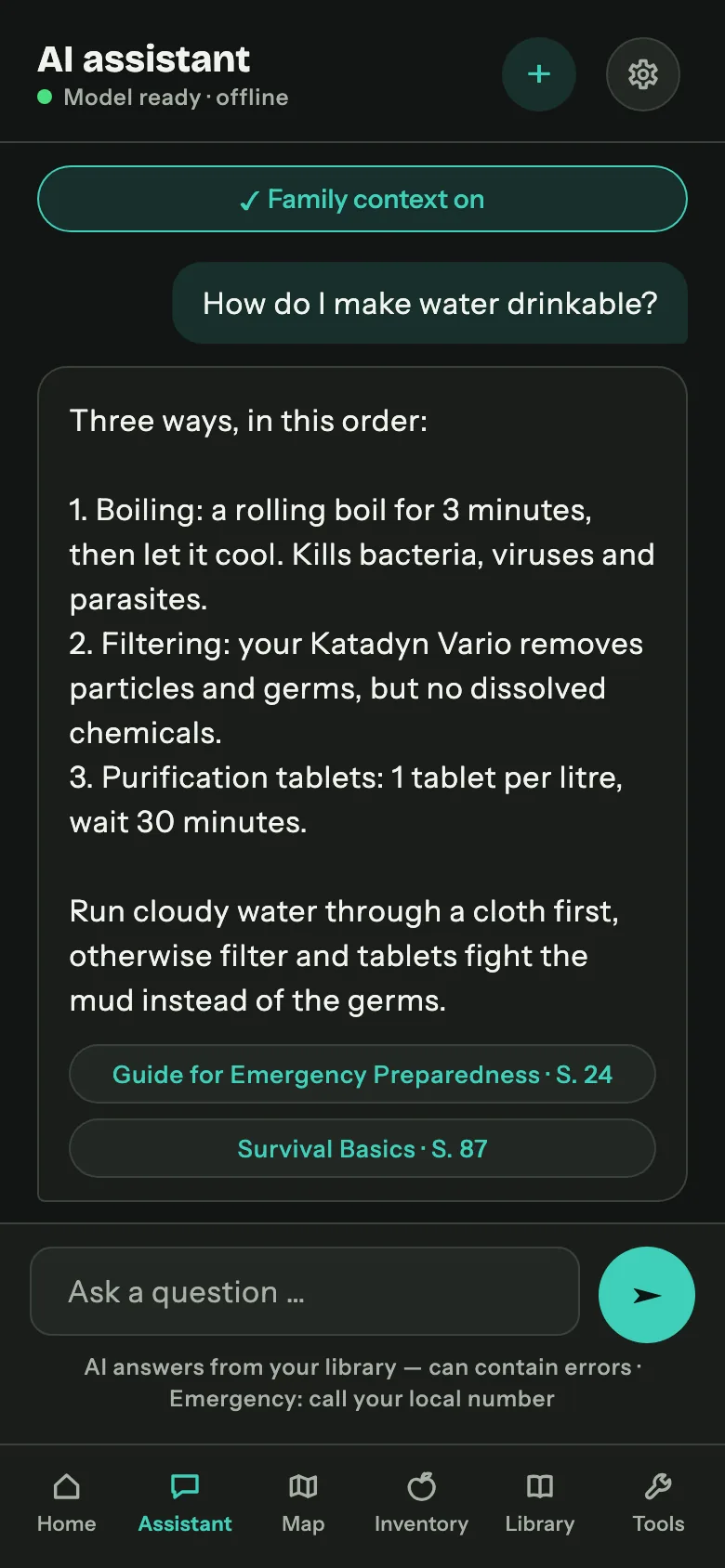
And the supply itself sits in the inventory, with a range in days instead of a gut feeling.
None of that matters at eleven at night if the torch is in a drawer nobody can find. Put a head torch and a radio with batteries somewhere you can reach blind, tonight, and the rest of this article becomes optional.