Water is the item most people underestimate when they build a stockpile. It is the heaviest and the bulkiest, and without it things turn life-threatening after about three days, no matter how full the shelf of cans is. Here is how much water your household actually needs, what to store it in, and what to do when the supply runs low. Building a water supply is not difficult, but it takes more than a crate behind the sofa.
How much water does a person need per day?
Germany's Federal Office of Civil Protection and Disaster Assistance (BBK) plans with two litres per person per day. That covers roughly one and a half litres for drinking and half a litre for cooking: the rice, the pasta, the instant soup, the coffee. Other drinks count towards it, so juice, tea and carton milk are included.
Two litres is a planning figure for an adult sitting quietly at room temperature. It is not a maximum and not a law of nature. The number climbs with heat, physical work, fever and diarrhoea, pregnancy and breastfeeding. Anyone clearing out a cellar in August does not drink two litres, they drink four. The simplest rule of thumb for a household: plan for one more person than actually lives there.
None of this covers washing, dishes and the toilet. That is the second and larger block, and it does not need drinking water quality. More on that below.
How much water does a family need for ten days?
Ten days is the official reference figure for a stockpile; many households now aim for fourteen or even twenty-one. The sum is people times days times two litres:
| Household | 10 days | 14 days | 21 days |
|---|---|---|---|
| 1 person | 20 litres | 28 litres | 42 litres |
| 2 people | 40 litres | 56 litres | 84 litres |
| 3 people | 60 litres | 84 litres | 126 litres |
| 4 people | 80 litres | 112 litres | 168 litres |
A litre of water weighs a kilo. Eighty litres for a family of four is therefore eighty kilos, about seven crates, a full car boot and a shelf that has to take it. That weight is why the water supply gets postponed to "next week" more often than any other item, and it is also the reason to start in stages: first a week's worth, then ten days, then the rest. Half a supply in the cellar is worth more than a whole one on a list.
Bottles or canisters: what should water be stored in?
| Container | Good for | Watch out for |
|---|---|---|
| Glass bottles in a crate | the core of the supply | Stay sealed and neutral in taste the longest, but they are heavy and they break. |
| PET crate from the shop | volume in a hurry | Light and cheap, but picks up taste over the years, so rotate more often. |
| 10 litre canister | decanting, transport, an actual emergency | Must say food grade (HDPE). Ten kilos can still be carried. |
| 20 litre canister | a standing reserve in the cellar | Barely liftable when full. Only where it stays put for good. |
| Collapsible canister, bathtub bladder | the event itself | Packs flat, gets filled when a warning comes. Not for long-term storage. |
What does not work: rinsed-out milk, juice and soft drink bottles. Sugar and protein residues stay behind in the threads and the cap, and they are an ideal growth medium for germs. The same goes for canisters that once held petrol, cleaning agents or antifreeze; the plastic never fully gives that back.
Where and how should a water supply be stored?
- Dark and cool. Light and warmth grow algae and age the plastic faster. Cellar, storage room, garage in winter. Not the windowsill and not the balcony.
- Not directly on a concrete floor. A board or a pallet underneath keeps moisture and odours from migrating out of the floor into the bottles. For the same reason, water does not belong next to paint, varnish, petrol or detergent: PET is not odour-proof.
- Leave it factory-sealed. An unopened bottle of mineral water keeps practically indefinitely. The best-before date describes the packaging, not the water. Once opened, the everyday rule applies: finish it within a few days, keep it cool, and do not drink straight from a bottle that then sits around for a week.
- Rotate instead of hoarding. As with food, first expired, first out: the supply gets drunk in everyday life and refilled on the normal weekly shop. Swap PET out once a year; glass may stand longer. Rotate nothing and in five years you own eighty litres that taste of bottle.
- Mind the weight. Eighty litres on a cheap shelf is eighty kilos on four thin metal feet. Store low, spread it out, and when in doubt use the floor.
Can you bottle tap water in advance?
As a long-term supply: no. German tap water is excellent, but it is not sterile. In a canister, at room temperature, without chlorine and with a little light, germs multiply within days. Self-bottled water keeps for days to weeks in a clean container stored cool and dark, not for years. If you really want to bottle your own, boil out the container, fill it to the brim and swap it regularly. The effort rarely compares well to a crate of mineral water.
As a reaction to a warning: absolutely. When a storm is announced, a boil water notice runs on the radio or the power starts flickering, that is the moment to fill everything clean you have: canisters, pots, jugs, buckets and the bathtub. Bathtub water is good for the toilet and for washing, and for drinking only if a bathtub bladder is lining it. A hot water tank in the cellar is a further reserve of eighty to two hundred litres that hardly anyone thinks of: switch the heating or the power off before draining it, and boil the water before drinking it. A tankless water heater, by contrast, stores nothing.
What if the water supply runs low?
The stockpile is the first layer, treatment is the second. It does not replace the supply, it extends it.
- Boiling is the standard. Bring it to a rolling boil and keep it there for a few minutes (health authorities usually say three minutes when a boil water notice is in force). That reliably kills bacteria, viruses and parasites. It does not remove chemical contamination, nitrate or heavy metals; they even concentrate as water evaporates.
- Purification tablets based on chlorine or silver are light, keep for years and work without fuel. Respect the contact time and put up with the taste.
- Filters have a limit. A hollow fibre filter holds back bacteria and parasites, but not viruses reliably. Activated carbon improves taste and binds some chemistry but does not disinfect. For cloudy surface water: let it settle and pre-filter it through a cloth, then filter, then boil it or use tablets.
- Rainwater is usable straight away for the toilet and laundry, as drinking water only after treatment. The first flush, the one that washes the dust off the roof, does not belong in the canister.
The second consumer, the one that gets overlooked, is hygiene. Brushing teeth, a quick wash, dishes and flushing add up to several litres per person per day even at maximum thrift. Non-potable water is fine for that: the bathtub, the rain barrel, the canister from the hardware store. A toilet bag system saves more water here than any other single measure.
How do you keep track of a water supply?
Two litres times people times days sounds like mental arithmetic, right up until the household consists of two adults, a toddler, a pregnant woman and a dog, and half the supply sits in the cellar while the other half hides behind the sofa. That is where Keepilo comes in: the household is stored with year of birth and sex, that yields the daily water requirement, and together with the stock it produces a single honest number: the range in days.
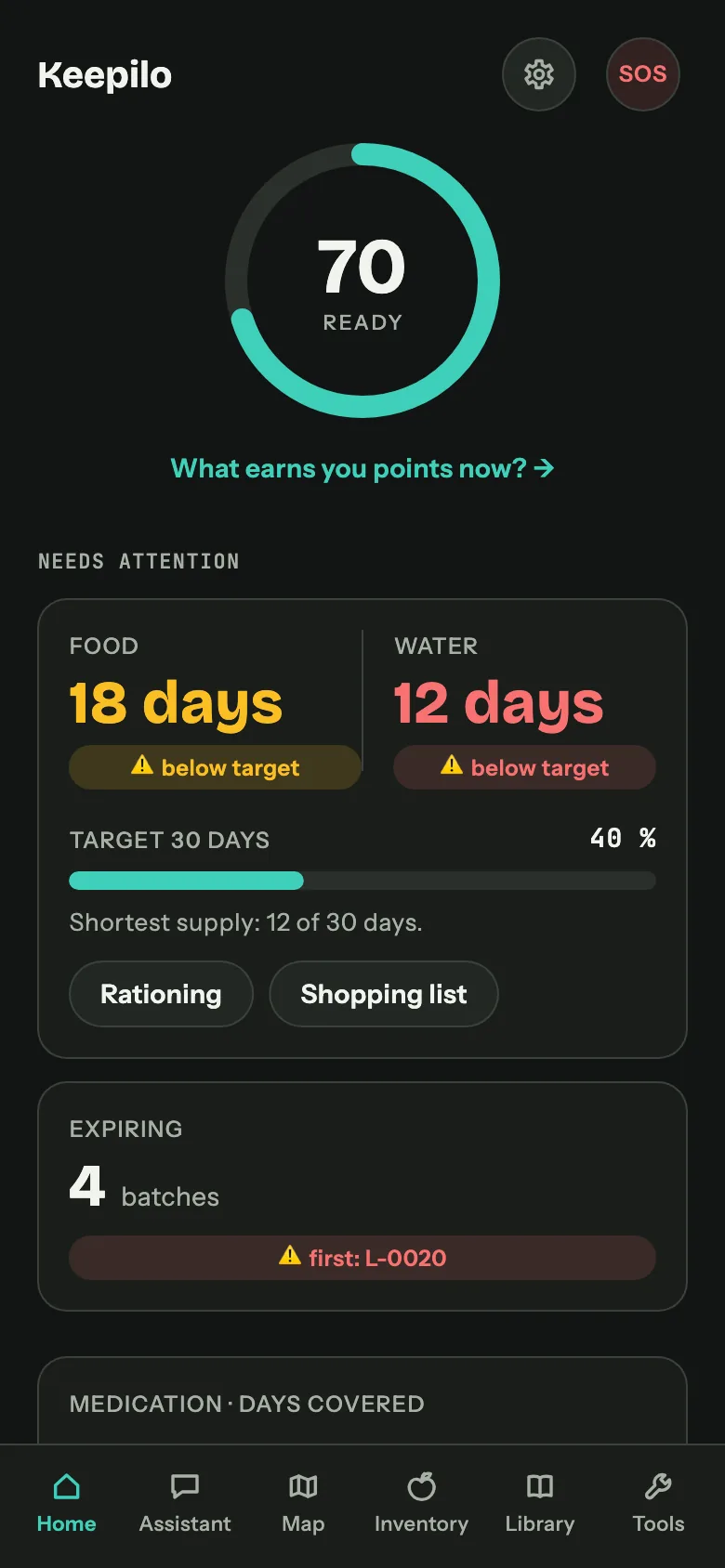
Water gets its own category and its own inventory numbers in the inventory. Water filters and purification tablets are special items: their capacity in litres counts towards your potential drinking water. Whatever is missing gets written up as a shopping list. All of it runs offline on the device, without an account and without a cloud, which is handy in exactly the situation the stockpile was built for.
If you are only just starting, the 10-day emergency food supply is the right next step: the same arithmetic, applied to food. And if you do only one thing today, buy the crate of water you have been meaning to buy for three weeks and carry it into the cellar.