Getting through ten days without shopping: that is the scale Germany's civil protection agency recommends. The good news: a 10-day supply fits into two moving boxes and requires no gear, just one planned shopping trip. Here is what belongs in it, with the official quantities and the mistakes almost everyone makes the first time.
Why ten days, of all numbers?
The German Federal Office of Civil Protection and Disaster Assistance (BBK) recommends a food and drink supply for about ten days. The number does not come from a doomsday scenario but from experience with perfectly ordinary situations: floods, a large-area power cut, a week of storms that cuts a district off. In the first days of such an event, authorities and helpers are busy where it is worst. Anyone who can look after themselves is not an additional emergency during that time.
Ten days is a reference, not a dogma. If you live in a flood area or depend on medication, you plan longer. What matters more than the exact number is that you have one at all, and that you check your stock against it.
How much does the official stockpile table recommend per person?
The German Federal Ministry of Food and Agriculture (BMEL) maintains a stockpile table for ten days on ernaehrungsvorsorge.de, calculated at around 2,200 kilocalories per day, which covers most adults. The quantities per person, rounded:
| Group | Amount for 10 days | Long-lasting examples |
|---|---|---|
| Drinks | 20 litres | Mineral water, juice. Drinking and cooking combined. |
| Grain, bread, potatoes | 3.5 kg | Rice, pasta, oats, crispbread, instant mashed potato |
| Vegetables, legumes | 4.0 kg | Canned vegetables count in full, lentils, beans, sauerkraut |
| Fruit, nuts | 2.5 kg | Canned fruit, dried fruit, nut mixes, apple sauce |
| Milk, dairy | 2.6 kg | UHT milk, hard cheese, milk powder |
| Fish, meat, eggs | 1.5 kg | Canned tuna and meat, whole egg powder |
| Fats, oils | about 0.4 kg | Vegetable oil, clarified butter |
On top of that comes what the table calls "as desired", and it is what separates survival from everyday life: sugar, honey, salt, coffee or tea, chocolate, stock cubes, and the spices that make your kitchen taste like your kitchen.
How much water belongs in an emergency supply?
Two litres per person per day is the planning figure, of which roughly half a litre goes into cooking. Coffee, tea and juice count towards it. For four people and ten days that is 80 litres, and it is the item most people underestimate: the heaviest, the bulkiest, and in a real event the first to run out.
A few things that help with storage:
- Store it factory-sealed. Mineral water in an unopened bottle keeps practically indefinitely; the best-before date describes the packaging, not the water. Glass stays tight longer than PET; PET bottles pick up taste over the years and should be rotated more often.
- Dark, cool, not directly on a concrete floor. A board under the crates keeps plasticisers and odours from migrating out of the floor into the bottles.
- Fill tap water only when an event looms. On a warning, fill the bathtub and clean canisters; that extends the supply by days. Tap water bottled far in advance goes stale within days unless treated.
- Treatment as the fallback. A water filter or purification tablets can make rain or stream water usable if it comes to that. That does not replace the stored supply, it extends it.
What about children, pregnancy, allergies and pets?
The table assumes an average adult; few households consist only of those.
- Children need fewer calories but familiar food. A crisis is a bad moment to introduce a child to lentil stew. Stock what is eaten anyway, plus some comfort: cocoa, biscuits, the favourite fruit purée.
- Pregnant and breastfeeding women sit well above the average requirement, in calories and especially in water. Planning for one extra person is the simplest rule of thumb.
- Allergies and intolerances must be reflected in the stockpile, precisely because there is no way around them in an emergency. A gluten-free household needs a gluten-free stockpile, and the neighbours cannot help with that.
- Pets appear in no calorie table but sit in front of the same empty bowl: count food and water for ten days, plus medication if the animal needs any.
- Long-term medication is the special case with the longest lead time, because a prescription sits in between. Work out the range per person and talk to your doctor before it gets tight.
What are the most common stockpiling mistakes?
- Pasta only. Five kilos of pasta feel like a stockpile but are a single food group. Without vegetables, fruit and protein, ten days of supplies become a one-sided week in a bad mood. The groups in the table are the point, not the calories alone.
- Storing what you do not eat. A stockpile is not a museum. Buy only what your family eats anyway, and eat the stockpile as part of everyday life: oldest first, replaced during the normal weekly shop. Nothing expires, and in an emergency there is food everyone knows.
- Leaving best-before dates to chance. If you do not write down what expires when, you discover the 2019 cans when you move house. A list on the cellar door is enough. An app that warns you by itself is more comfortable, but the principle is what counts: writing it down is what keeps a stockpile alive.
- Forgetting medication. In many households the medication supply is shorter than the food supply, see above, and nobody notices because nobody does the maths.
- No can opener, no stove. A stockpile of cans needs a manual can opener, and a power cut needs a way to heat water: a camping stove with cartridges, a fondue burner, at a pinch the balcony barbecue, but never charcoal indoors.
How does a stockpile stay fresh without anything expiring?
The trick is a rotating stockpile: you do not store a special ration for the emergency, you enlarge your normal household by ten days of buffer. You always use the shortest-dated items first and replace what you used. Warehouse people call it first expired, first out. Nothing ages, and in the long run the stockpile costs only the initial purchase.
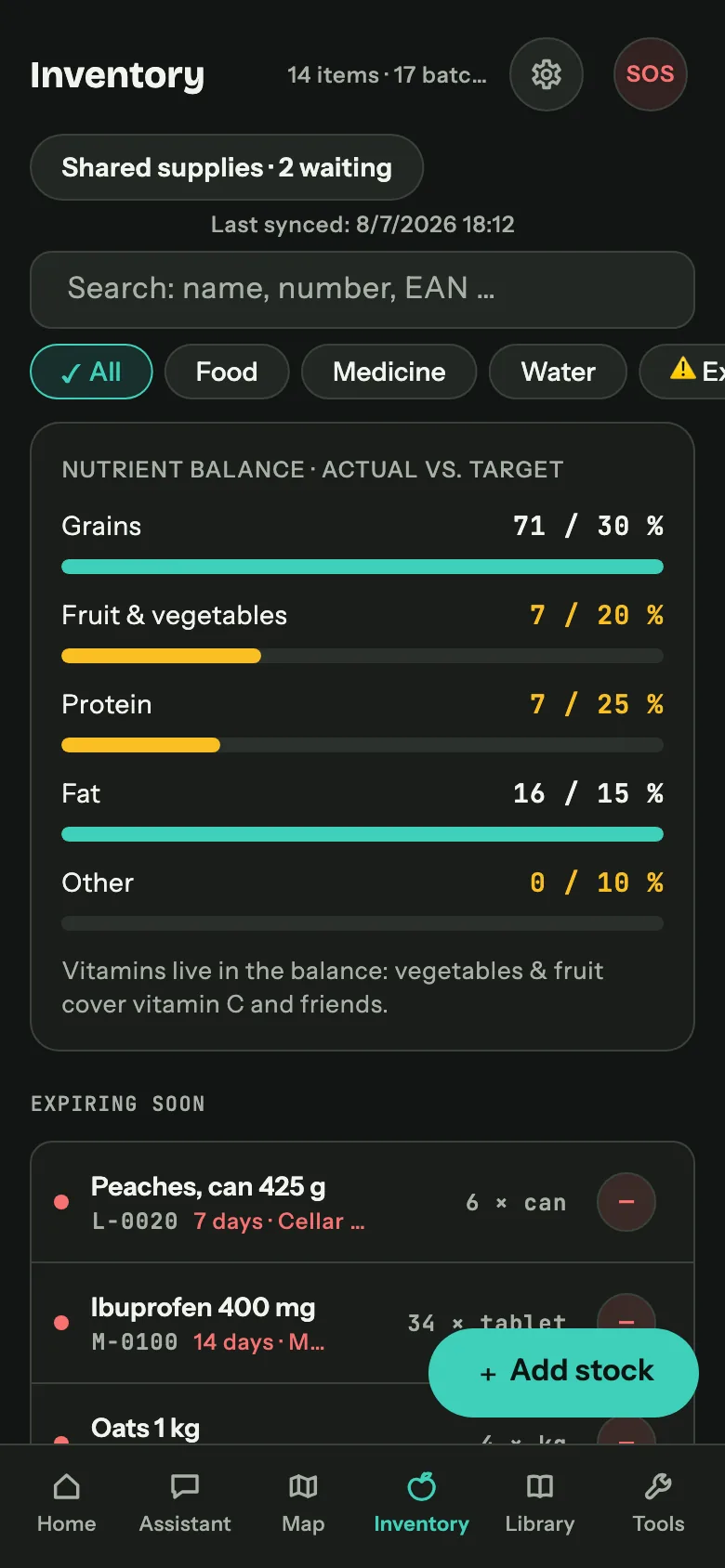
That bookkeeping is exactly what Keepilo does if you would rather not run it on paper: the app knows your household, derives the requirement from age and sex, compares it with your stock and turns the gap into a shopping list with actual products following this same official table. It watches the best-before dates on the side, fully offline. But app or notepad: start with one shopping trip. Two boxes, one afternoon, and the next storm warning is a weather report instead of a threat.