The moment arrives for everyone who builds a stockpile. You stand in front of the shelf in the cellar, you see tins, rice, crates of water, and you realise: it looks like a lot, but nobody in the house could say how many days it covers. That number is the only one that matters, and nobody has written it down. Managing a stockpile is really just the work of keeping that one number honest.
Why a stockpile becomes invisible
A stockpile is not built in a day. It grows over months, and it grows in several places at once. Some of it is in the cellar, some in the kitchen, some in the garage, and somewhere behind the sofa there are still two crates of water from the last storm. There is no moment at which anybody sees all of it together.
Then three things eat away at whatever picture you had:
- The stockpile gets raided. Six tins become four because there was nothing else in the house on a Sunday. Nobody replaced them and nobody noticed.
- Best-before dates pass quietly. A ten-day supply that is a third out of date is a seven-day supply, and it still looks exactly like a ten-day one.
- Same product, different dates. Twelve tins of peaches on the shelf are really five from 2024 and seven from 2026. As a single line on a piece of paper they are indistinguishable.
The result is remarkably consistent: the stockpile people feel they have is considerably larger than the one they actually have. Anyone who does the arithmetic for the first time almost always comes out below their own estimate.
The paper list, the spreadsheet, and why both die
The list taped to the cellar door is the honest beginning and works for about six weeks. Then something gets taken three times without anyone marking it off, and from that point on the list lies. Its real weakness is not discipline but dates: it knows there are twelve tins, not that five of them expire next month.
The spreadsheet is attempt number two and a clear improvement. It calculates, it sorts, it can handle expiry dates. It fails somewhere else: nobody keeps it up in passing. Nobody opens a spreadsheet on a computer while walking from the cellar to the kitchen with a bag of pasta under one arm. Anything not recorded in the moment it happens never gets recorded at all.
So the real requirement is not "more features" but five seconds on a phone, in the cellar, with no signal.
What a supply system genuinely has to do
Whatever tool you use, five things decide whether the system still tells the truth a year later:
| Requirement | Why it matters |
|---|---|
| Record partial amounts | Half a packet is normal. A system that only knows whole units drifts away from reality within weeks. |
| Batches with their own dates | Same product, different best-before dates. Without that separation, any range figure is a guess. |
| Needs worked out from who actually lives there | A toddler, a teenager and an eighty-year-old do not need the same amount. Flat averages are almost always wrong for an individual household. |
| Range, not stock counts | "Lasts 18 days" is understandable; "147 items recorded" is not. Only the first one makes anyone do anything. |
| Offline and account-free | A supply system that needs a network in an emergency is gone at exactly the moment you first open it in earnest. |
Where the daily requirement comes from
Range is a division: stock divided by daily requirement. The second number is the harder one. The usual reference values are around 2,000 to 2,500 kilocalories per adult per day (depending on age, sex and activity) and two litres of water per person per day, the planning figure used by Germany's BBK. Children are well below that, teenagers in a growth spurt sometimes above, and so are pregnant and breastfeeding women.
For an individual household that means a flat "2,000 kcal times number of people" is too high for two adults and two small children, and too low for two adults and two teenagers. That is not a detail: it can easily be worth several days of range. The quantities in the piece on the 10-day emergency food supply come from the official German stockpile table, which works with one flat figure per adult; the values graded by age and sex come from the German Nutrition Society. Water works the same way and has its own piece.
How Keepilo does the arithmetic
This is exactly where Keepilo starts. The household is entered once, a year of birth and a sex for each person, plus an override for anyone who needs more. That produces the daily requirement for calories and water, and every value shows where it came from: your own override beats the age profile, the profile beats the general reference value. There is no number in the app that does not explain its own origin.
Stock is recorded in the inventory, in the way it actually happens in a cellar:
- Adding stock step by step: name, quantity, unit, best-before date, storage location. On a phone the barcode scan fills in whatever it can.
- Batches stay separate. The same product with two dates is two batches, each with its own status light and its own location.
- Removing stock in partial amounts, with a reason (used, expired, given away). The batch with the earliest date is always suggested first: first expired, first out.
- Inventory numbers such as
L-0042for food orW-0003for water get written on the box with a marker and looked up in the app. That is the point at which a wall of shelving becomes searchable.
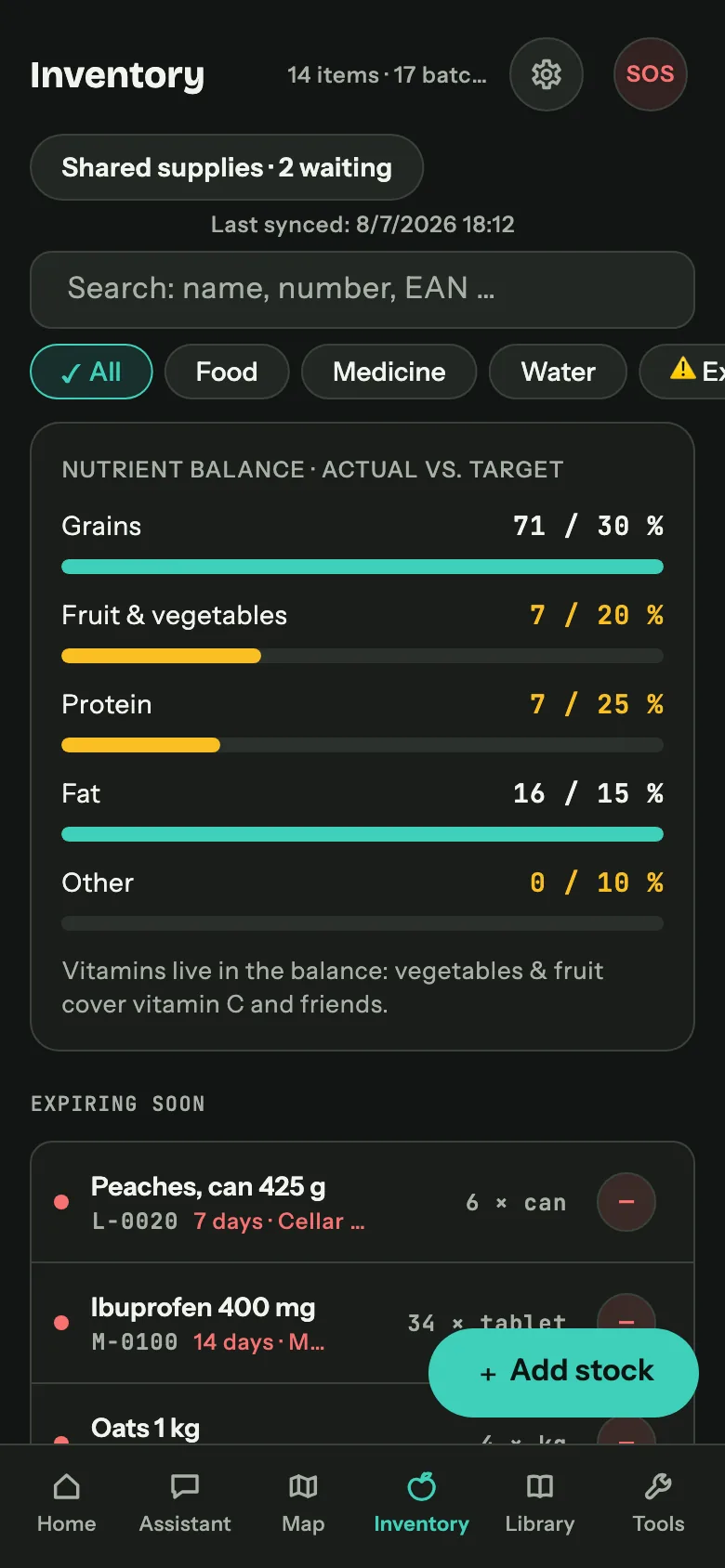
The dashboard then shows the range in days, separately for food and for water, measured against the target you set yourself (ten days is the common official recommendation; many households aim for fourteen or twenty-one). Next to it: what expires first, by name, and how long each person's medication lasts, worked out from dose and stock. The readiness score condenses all of it into a single figure, together with the emergency plan and the go bag checklist, and underneath it sits exactly one suggestion: the next sensible thing to do.
Run the sum backwards and you get the shopping list: the gap between where you are and where you want to be, converted into the pack sizes shops actually sell ("6 × 1 L long-life milk") using the official stockpile table. Tickable, shareable as plain text, and plain text survives every messenger.
No account, no cloud
A supply inventory says a great deal about a household: how many people live there, how old they are, what medication they take, when nobody was home. That is not data for somebody else's server. In Keepilo everything stays on the device. There is no registration, no user account, no background analytics, and no connection needed at all once the content has been downloaded once.
If you want the inventory kept in step across two devices in the household, you can switch that on; every change is then encrypted on the device, and only items and stock levels travel, never the documents, the people or their health data. It is off until you turn it on.
What an app cannot do
In fairness: no software does your shopping, and no number feeds anyone. An app can make the stockpile visible, flag expiry in time and take the arithmetic off your hands. It cannot stop somebody taking three tins and saying nothing. In the end, the difference between a system that holds up and one that does not is a single habit: record it while you are standing at the shelf, not later at a computer.
Water is the place to start, because it is the shortest range in almost every household and takes about ten minutes to record. The number that appears afterwards tends to do the persuading on its own.