A stockpile and an emergency backpack are two different things, and they get mixed up constantly. The stockpile exists so you can stay at home. The rucksack exists so you can be out of the door in twenty minutes. One sits in the cellar and weighs eighty kilos; the other sits next to the front door and must not weigh more than you can carry for an hour. What really belongs in a go bag follows from that one constraint.
When do you actually need an emergency backpack?
Not in an apocalypse, but on an ordinary Tuesday. The realistic reasons for having to leave your home at short notice have not changed in years: an unexploded wartime bomb being defused in a residential area (in German cities like Cologne, Hanover or Frankfurt several times a year, and the largest of those evacuations have moved tens of thousands of people), a gas leak, a fire elsewhere in the building, a flood, a chemical accident, storm damage to the roof.
Planned bomb disposal is announced days in advance, so there is time. For everything else you have between twenty minutes and two hours, and nobody is let back in that day to fetch anything. What counts then is not your equipment but the time you do not spend searching. That is the whole point of a packed rucksack.
The official list, ordered by what hurts first
Germany's Federal Office of Civil Protection and Disaster Assistance (BBK) publishes a go bag list in its preparedness guide. It is a good list, but it is only a list: nothing on it is ranked, and that is exactly where it fails in practice. Work through it from top to bottom and you pack the sleeping mat and the toothbrush before you think about your documents. So here it is sorted by urgency, because someone who stops packing at item four should have packed the four items that matter most.
| Rank | What | Why here |
|---|---|---|
| 1 | Document folder, cash in small notes | Irreplaceable and almost weightless. Without papers, everything else takes weeks. |
| 2 | Medication, medication plan, small first aid kit, spare glasses | Repeat prescriptions are not easy to come by in an emergency shelter. |
| 3 | Phone, charging cable, charged power bank | Contact with family, warning messages, paying for things. |
| 4 | One litre of water, collapsible bottle, purification tablets, bars and nuts for two days | Water is the heaviest item: carry a little, and carry the means to refill it. |
| 5 | Weatherproof jacket, sturdy shoes, change of clothes, a warm layer | Standing outside and waiting is the most likely part of any evacuation. |
| 6 | Head torch with spare batteries | Hands free, no fire risk, works in an unlit stairwell. |
| 7 | Sleeping bag or blanket, thin sleeping mat | A sports hall floor is hard and cold, and the blankets there run out fast. |
| 8 | Hygiene: toothbrush, soap, towel, toilet paper, wet wipes, bin bags | Little weight, a lot of dignity. |
| 9 | Battery or wind-up radio | Your source of information when the mobile network is congested. |
| 10 | Pocket knife, cup, spoon, tape, cable ties | The small things you miss most when they are not there. |
Item one deserves an article of its own, because you cannot buy it back at all, only apply for it again. What belongs in the emergency document folder is covered there in detail. The rucksack only needs the folder itself, or a copy of it, right at the top under the lid.
Weight is the real problem
Every go bag list on the internet can be packed in full. The result weighs twenty-five kilos, sits in the hallway, and gets left behind on the day it matters, because nobody carries it down the stairs. A bag you do not carry is not an emergency bag, it is furniture.
As a rule of thumb: around ten kilos for an average adult, less with a bad back or bad knees, noticeably less for children. If you are unsure, pack the bag and walk around the block with it, stairs included. It takes ten minutes and settles the question for good.
What saves weight without costing you anything:
- Ration water, do not stack it. One litre per person in the pack, plus a collapsible bottle and purification tablets. Carrying four litres is the most common beginner's mistake. The household total is a different calculation; the water piece has it.
- Food that needs no cooking. Bars, nuts, dried fruit, biscuits. Tins are heavy, need an opener and usually a stove. The stove belongs in the stockpile at home, not in the pack.
- Clothing in layers, not in quantity. One thin down or synthetic-fill jacket replaces three jumpers at a fraction of the weight and bulk. Fleece is warm, but it saves you neither.
- Spread the load across the family. Four rucksacks of seven kilos move far more easily than one of twenty-eight. Everyone carries their own clothes and their own water.
Children, older relatives, pets
From about four years old, children carry a small rucksack of their own, and the most important thing in it is not equipment: a soft toy, a book, a pack of cards. For a child, an evacuation is mostly waiting in an unfamiliar hall full of loud adults. Add a note in the coat pocket with their name and their parents' phone numbers, handwritten in capitals rather than saved on a phone. For babies: food, nappies and a change of clothes for two days. That weight is not negotiable, so the adults carry it.
With older or dependent relatives it is the preparation that decides, not the kit: the medication plan, the aids (hearing aid batteries, spare glasses, walking stick), the number of the care service, and, agreed in advance, who collects them.
Pets need a carrier or a lead with a harness, food and water for two days, a bowl, the vaccination record and the microchip number. Emergency shelters do not automatically take animals; a plan B with friends outside the affected area spares you the worst decision of the day.
What you can safely leave out
The preparedness market runs on one fact: kit sells better than preparation. These do not belong in the pack: machetes and axes (useless in a sports hall, and carrying one in public gets you into trouble rather than out of it), tactical vests, gas masks (worthless without fitting, the right filter and practice), five-litre water canisters, tins and the opener to go with them, a tent, a generator. Nor a fortnight's food: that is the stockpile at home, and it stays at home.
What most lists leave out and everyone ends up wanting: earplugs and an eye mask for a night in a hall, a pen and paper, and a printed list of the phone numbers that matter. The bin bags from item eight double as a rain cover and something dry to sit on.
Where it lives, and how often to check it
The rucksack lives near the door, not in the cellar and not in the loft. Everyone in the household has to be able to find it in the dark. Once a year it gets emptied out: swap batteries, replace bars and water, check medication expiry dates, adjust children's clothing sizes. Tying it to the same date as the smoke alarm check or the clock change works well, because then it is not another thing to remember.
The packing list you can tick off
A list on paper is good until it is two years old and nobody knows whether the ticks still hold. In Keepilo the go bag checklist sits in the emergency area: twenty-six items based on the BBK recommendations, reworded in plain English, with a separate tick for each person. If you are packing four rucksacks, you can see at a glance which one is not finished.
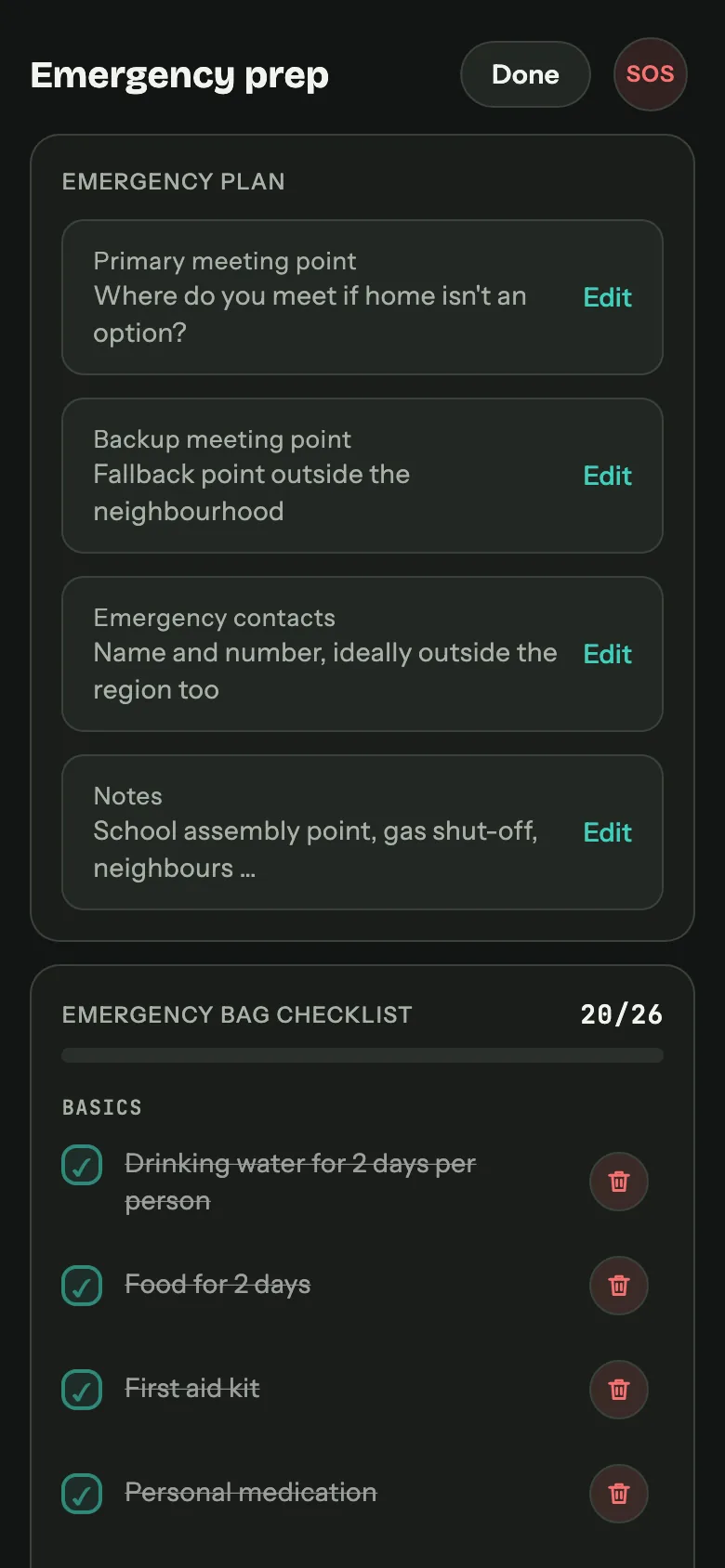
That progress feeds into the readiness score alongside food and water, so a half-packed rucksack does not go unnoticed for months. The emergency plan next to it holds meeting points and contacts, and the app prints the credit-card-sized emergency cards as a PDF. All of it lives on the device and works without a network, which is convenient when you are standing in the stairwell with the bag on your shoulder.
Nobody assembles the perfect kit in one evening, and the people who try tend to buy nothing at all. An old sports bag with items one to four in it already does most of the work.