You can replace supplies, and you can replace a radio. A birth certificate that has sat in floodwater and an insurance policy that has burned cost you weeks of chasing paperwork, and they cost you those weeks at the exact moment when nothing else is working either. That makes the document folder the part of preparedness with the best ratio of effort to payoff: one afternoon of work, then a check once a year.
Why papers disappear faster than people expect
The usual cases are unspectacular. A burst pipe in the cellar where the files are kept. A cellar fire where it is not the flames but the water from the hose that ruins the folders. A flood that stands sixty centimetres deep overnight. An evacuation for bomb disposal that leaves twenty minutes to get out of the building. In none of those does anyone have time to search three ring binders for a vaccination record.
Then, once the water has gone, the paperwork starts. The insurer wants to know what was in the house. The council wants proof before it will pay out emergency aid. The landlord wants the tenancy agreement. The bank wants an ID document that no longer exists. With the papers you are back on your feet in days; without them it takes months.
Which documents belong in the folder?
Germany's Federal Office of Civil Protection and Disaster Assistance (BBK) keeps a list for this, and it has been in its preparedness guide for years. Sorted by what you actually need when it matters:
| Area | What | Original or copy |
|---|---|---|
| Identity | ID card, passport, birth and marriage certificates, family record book, residence permit | Original in the folder, copy in a second location |
| Health | Vaccination record, allergy card, emergency medical card, medication plan, disability card | Original |
| Money | Insurance policies, bank paperwork, savings books, share and fund statements, pension statements | Original |
| Home | Tenancy agreement, purchase contract, land register extract, building insurance | Original or certified copy |
| Advance directives | Power of attorney, living will, care directive, your will | Original, copy with the person who would act on it |
| Work | References, qualifications, employment contract | Original: replacements take months to obtain |
| Vehicle | Driving licence, vehicle registration documents | Keep the ownership document (in Germany, Part II) out of the car |
| Pets | Vaccination record, EU pet passport, microchip number | Original |
| Evidence for the insurer | Photos or video of every room, receipts for expensive appliances | Digital |
That last item is the one most often forgotten and the fastest to do: walk through the flat once with your phone, every drawer and cupboard open, record a video, then photograph the receipts for the expensive things. Twenty minutes, and the question of what was in the flat at all is answered before the insurer asks it.
Where does the folder live?
Three levels, all of them simple.
- Within reach. A sturdy folder, ideally inside a waterproof sleeve, in a place everyone in the household knows and can find in the dark. Next to the emergency backpack is the right spot, not at the bottom of the cellar. A folder you are meant to grab on the way out has to be within reach of the way out. And when the power is gone, you will only find it if it always lives in the same place.
- Spread out. A second set of copies somewhere else: with parents, siblings, close friends, in a safe deposit box. Anything stored in one place is lost on one day. A power of attorney and a living will are no use in a drawer at home either: the person who is meant to act on them has to have a copy in their own hands, and banks and hospitals will usually want the original of a power of attorney.
- Digital. Every document photographed or scanned once. That version survives water and fire as long as it is not sitting in the same room as the paper, it fits in a pocket, and it is the only copy you have with you when the folder is at home.
Fireproof boxes are popular and fine, but they have a catch: nothing locked away in a cupboard gets grabbed by anyone running out the door. If you use one, put a set of copies and a USB stick in the top of the rucksack as well.
Digital copies without someone else's cloud
The obvious route is to upload everything to cloud storage. Convenient, but it means your ID, health data, bank paperwork and powers of attorney sit on a stranger's server, often outside your own jurisdiction, and their safety rests on one password and the diligence of a company that does not know you. For these particular papers, that is the wrong filing cabinet.
The simple rules for the digital second copy:
- Encrypted or not at all. Either an app that encrypts on the device, or a container (VeraCrypt, an encrypted disk image) on a USB stick.
- Two copies, two places. One stick in the rucksack, one with someone you trust. Sticks die quietly; read and rewrite them once a year.
- Stay readable. PDF and JPG, never a format that is worthless without one particular app. A filename you understand is worth more than any folder structure.
- Paper stays paper. A scan does not replace a certificate and no authority will accept it as an original. It is the bridge until the original is reissued, and it makes that reissue considerably faster.
What belongs in your wallet
An emergency card in your wallet is the smallest step of the lot, and the one that actually gets used. On it: emergency contacts with the relationship spelled out ("sister"), blood group if known, allergies, regular medication, chronic conditions, family doctor. For children, a note with the parents' numbers goes in the school bag and in a coat pocket, handwritten in capitals rather than saved on a phone.
The reason is unromantic. Paramedics look at the wallet first, not at a locked phone. And at the moment somebody needs that card, they usually cannot tell you any of it themselves.
How Keepilo covers the document folder
Keepilo has two areas for this, and they work together. The vault holds the digital copies: ID documents, policies, certificates, powers of attorney. They sit encrypted on the device behind their own app lock, and they do not go to a cloud, because Keepilo does not have one. If you sync your stock between two devices, the vault stays out of it: only items and stock levels travel, and nothing about the people in your household ever does.
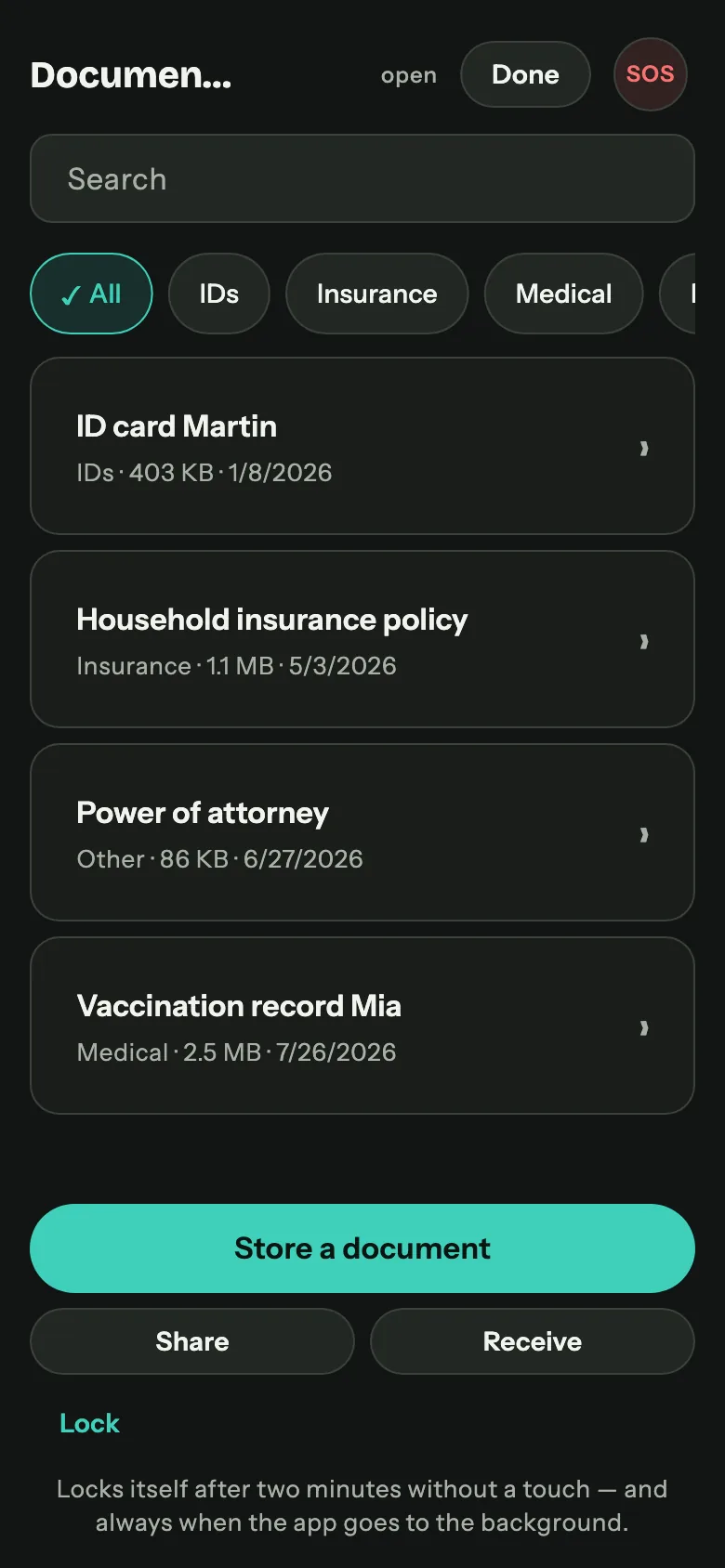
The emergency area holds what belongs on paper when it counts: emergency contacts, and a medical card for each person in the household, with allergies, regular medication and existing conditions. From those the app generates credit-card-sized emergency cards as a PDF. Print once, cut out, put one in the wallet and one in the rucksack. The rest of your preparation sits alongside it: the inventory for supplies, the assistant for the questions you ask in the dark.
The honest part at the end: building this folder takes an afternoon and is no fun at all. But it is the one piece of preparedness that pays off even if no crisis ever comes, and all that ever happens is a water leak, a house move or a death in the family. Take a Sunday afternoon, and set yourself a reminder for next August.